
From Ideation to ROI: The Process with Proforma Behind Successful Leisure Projects
ProForma and I have worked with a number of key developers in the region over the last few years, across projects ranging from fully master planned sites, to leisure options within mall environments, to large scale anchor attractions with hotels attached.
We make a good team. Between us there is over 100 years (that makes me feel old!) of experience and quite a few degrees, so we like to think we know what we are doing. We each bring our own specialism to a project, and collectively we have travelled the world seeing concepts first-hand and understanding the nuances and comparables of each. This allows us to bring a genuinely global viewpoint when advising on projects in the Middle East market.
Having lived in the Middle East for nearly twenty years, I feel I have a strong grasp of the market. If I don’t know the answer to something, I will usually know someone who does… and if not, I will make sure I find out. I take this approach because I am a firm believer in data-led strategies. “Build it and they will come” is not a strategy for success; even educated guesses are better than pure guesses. This is where the team at ProForma and I fit in. Together we undertake first-party, data-led economic studies designed to ensure the long-term success of venues and concepts.
Leisure and entertainment assets today work harder than ever. They drive footfall, influence dwell time, support retail and F&B performance and shape destination identity. For developers and asset owners, we provide commercial asset strategy and economic consultancy for leisure and entertainment within mixed-use and retail environments. This includes market intelligence, feasibility studies, programming strategy and the integration of location based entertainment, hospitality, retail and F&B to strengthen overall destination performance.
Middle East developers generally fall into two camps when seeking economic studies:
Those with a high-level design already conceptualised and those searching for the bright idea that will become the anchor for a new project. While the starting points may differ, the methodology is often very similar.
An economic study is the process that turns an initial idea into an evidence-based roadmap for investment, creative direction and operations. It moves systematically from concept definition through market analysis, competitive benchmarking, design and capacity planning, financial modelling and finally investment recommendations.
ProForma and I work through a well-practised methodology originally formulated by the Stanford Research Institute in 1953 for the design of Disneyland. It continues to be utilised across leisure, entertainment and sports projects around the world to this day.
Depending on the project, our methodology can include several stages, but an abbreviated version is outlined below.
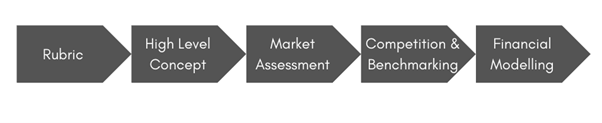
Stage Minus One – A Rubric
(utilised when there is no conceptualisation or clear idea for the leisure and entertainment offer within a project)
Working closely with the client, a leisure and entertainment options rubric, essentially a weighted scoring guide, is drafted and analysed. This lists the criteria for the project, including any client-specific needs, with the aim of filtering and prioritising preferred concepts for the site.
Stage One – High Level Conceptualisation / Ideation
The true starting point of a project is when a clear (non generic*) concept has been agreed. Ideation can include details such as the number and types of coasters, the allocation and size of F&B and retail areas, and the intended target market, whether tourists, residents or both.
It may also involve decisions around intellectual property and how it might be attached to the venue. The more detail there is around the concept, the more precise the economic study can be.
However, it is not unusual for an initial study to be undertaken with limited ideation, followed by a more detailed concept revision. For example, the original concept may have included certain types of coasters which are later replaced with smaller attractions with higher throughput. Alternatively, a digital immersive show or after-dark programme may be introduced, increasing footfall, dwell time and spend per capita.
Stage Two – Market Assessment
Once a concept is defined, we undertake a detailed catchment assessment to understand who can realistically visit the project and how often. This helps formulate the overall penetration rate**, taking income qualification into consideration.
Part of this process also includes analysing drive times, transport infrastructure and accessibility, along with tourism potential depending on the location and target market of the venue. These calculations provide a quantified view of the potential market for the concept.
Stage Three – Competition and Benchmarking
Current and future supply is then assessed. This is one of the most important parts of the process. Understanding similar projects in the market, both regionally and internationally, along with future supply, can have a direct influence on the success of a venue.
Site visits locally and internationally are an essential tool, and there is a significant amount of personal “shoe leather” involved in ensuring that the data remains as up to date as possible.
Insights collected can include:
Ticket pricing
Ticket types
Opening hours
Dwell time
Demographic profiles
…and many other operational data points.
Benchmarking both locally and internationally provides valuable learning opportunities across areas such as operations, CAPEX, design and consumer behaviour. Alongside market assessment, it also helps determine the correct sizing of a project.
Stage Four – Financial Modelling
The financial modelling phase converts all the previous inputs into multi-year projections. Working closely with the client, we develop scenarios across key metrics including attendance, ticket and non-ticket revenue, per capita spend, OPEX, EBITDA and ROI.
This stage can also explore additional revenue streams such as sponsorship, events or IP licensing.
Outcome – Interpretation and Recommendations
Finally, the results are interpreted to answer the core question: Is the concept economically feasible?
We also identify success factors and risks, and recommend whether to proceed, adjust or redesign elements of the project. A well-structured leisure and entertainment feasibility report becomes a data-led roadmap for design, CAPEX investment and eventual operation, as well as a core reference document for all stakeholders involved.
If you would like to work with over 100 years of combined experience and more air miles of benchmarking than I can probably count, it would be great to connect.
Foot notes:
* Generic attractions— alike an indoor family entertainment centre, a destination theme park, a branded immersive attraction, or an